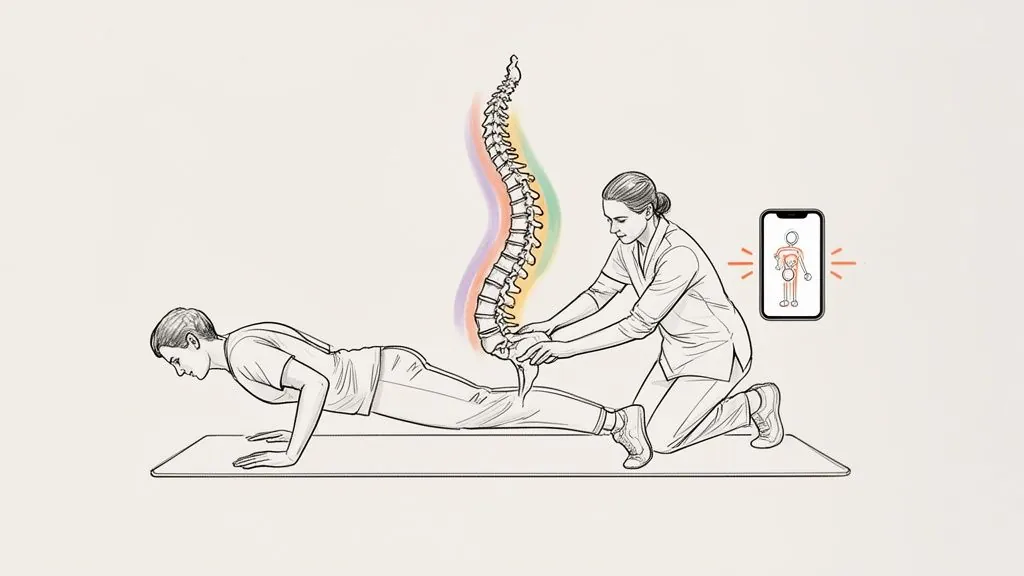
When it comes to exercising for scoliosis, the key isn't just about strengthening your back; it's about asymmetrical correction. This is a very specific approach that involves targeting the weak, overstretched muscles on one side of your curve while gently lengthening the tight, compressed muscles on the other. The goal is to create a more balanced and supportive core.
Understanding Scoliosis and Why Specific Exercises Matter
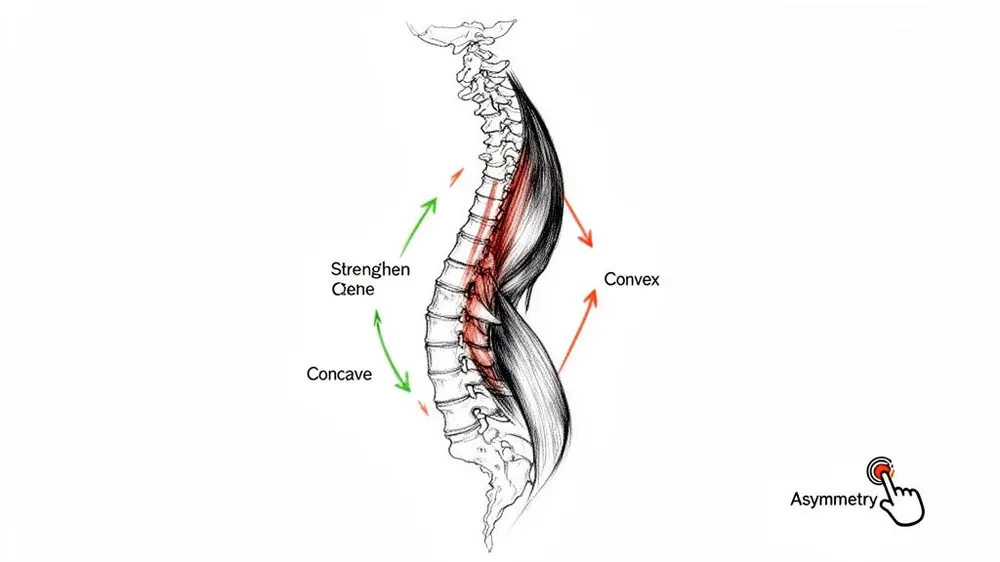
It’s easy to look at an X-ray and see scoliosis as a simple sideways curve. But in practice, it’s a complex, three-dimensional condition. The spine doesn't just bend; it rotates, affecting your entire trunk: your ribcage, your muscle symmetry, and even how you breathe. This is precisely why generic back exercises often miss the mark and can sometimes make the imbalance worse.
Think of it like a tent pole that has a slight bend. If you just pull on all the guide ropes with equal force, you’ll likely deepen the bend. The only way to straighten it is to be strategic: you need to loosen the ropes on the tight side of the bend and pull harder on the slack side. Your spine works in much the same way, and scoliosis-specific exercises are designed to create these corrective forces from the inside out.
The Principle of Asymmetrical Correction
This brings us back to the core idea of asymmetrical correction. Any spinal curve creates a "concave" side (the inside or 'hollow' of the curve, where muscles become tight) and a "convex" side (the outside or 'hump' of the curve, where muscles are overstretched and weak). An effective exercise program must address this imbalance head-on.
Strengthening the Convex Side: The muscles on the outside of your curve are constantly being pulled long and often become quite weak. We use targeted exercises to wake up these muscles and build strength, helping to pull the spine back toward a more centred position.
Lengthening the Concave Side: On the inside of the curve, everything gets compressed. The muscles and soft tissues become short and tight. Specific stretches and corrective breathing techniques help to lengthen these tissues, de-rotate the vertebrae, and create more space along the spinal column.
This targeted strategy is the bedrock of well-established physiotherapy programs like the Schroth Method, which falls under the umbrella of Physiotherapy Scoliosis-Specific Exercises (PSSE). While not a "cure," these methods are a powerful way to manage your condition, improve posture, reduce pain, and in many cases, slow or even stop a curve from progressing, especially for adolescents.
Key Takeaway: The goal of scoliosis-specific exercise isn't to force your spine perfectly straight. It’s to build a more stable, balanced, and functional trunk by directly correcting the unique muscular imbalances caused by your specific curve.
Measuring What Matters for Effective Exercise
To put these principles into action safely, you first need to understand your own body. That starts with knowing your curve pattern and its severity, which is professionally measured on an X-ray using the Cobb angle. If you're new to this, our guide on understanding Cobb's angle in scoliosis is a great place to start.
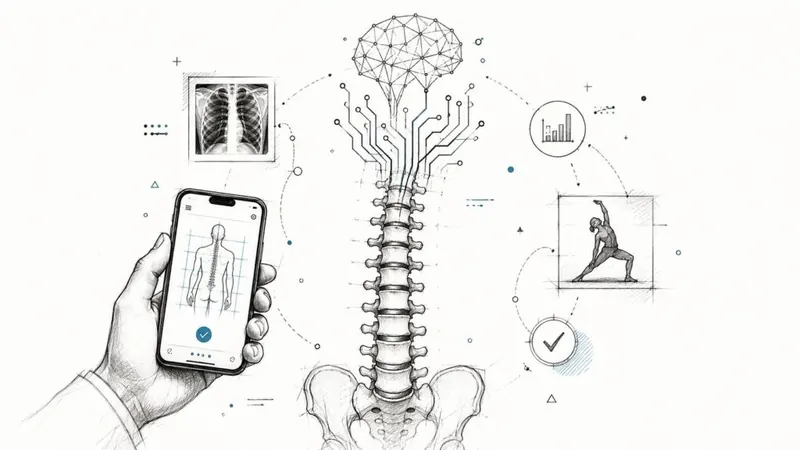
Historically, tracking your progress at home has been the biggest challenge. You can't get frequent X-rays because of the radiation exposure, so how do you know if your hard work is paying off? This is where technology is making a real difference. Modern tools like the PosturaZen app allow you to monitor key postural changes without any radiation, right from your phone.
Using your phone’s camera and advanced analysis, you can get reliable feedback on:
Your estimated Cobb angle
Shoulder and hip alignment
The position of your scapulae (shoulder blades)
This gives you a clear, real-world picture of how your body is responding to your exercise program over time. Seeing tangible improvements in your posture is incredibly motivating and helps you and your clinician make smarter decisions about your routine. This feedback loop is what empowers you to take control of your scoliosis management.
Core Stability Exercises You Can Start Today
Building a truly strong and stable core is the absolute bedrock of any good scoliosis exercise program. Before we can even think about the more complex, asymmetrical movements, we have to teach your deep core muscles how to fire up correctly and hold your spine in a neutral, supported position.
Think of these foundational exercises less like a workout and more like re-educating your body. Over time, we all develop little cheats and faulty movement patterns, and scoliosis can amplify this. The goal here is to overwrite those bad habits with new ones that promote spinal stability and take the pressure off your curves.
Mastering the Bird-Dog for Rotational Control
The Bird-Dog is one of my go-to exercises for anyone with scoliosis. Its real magic lies in teaching your body to fight against rotation while keeping the spine stable and neutral. This is a game-changer for a scoliotic spine, which by its very nature involves a rotational component.
Here’s how to get the most out of it:
Start on all fours, stacking your hands directly under your shoulders and your knees right under your hips. Your back should be flat enough to rest a cup of tea on it.
Next, gently brace your abdominal muscles. It’s the same feeling as if you were about to be gently poked in the stomach – you’re creating stiffness, not sucking in.
Now for the movement. Slowly, and with total control, extend one arm straight forward and the opposite leg straight back. The whole trick is to do this without letting your hips rock or your lower back sag.
Hold that extended position for a solid 3-5 seconds. Feel the stability? Your entire torso should be rock solid. Then, bring your arm and leg back to the start just as slowly as you extended them.
Quality is everything here. It's far better to do 6-8 perfect reps on each side than to rush through 15 sloppy ones. If you feel yourself wobbling or arching, you're either moving too fast or extending too far.
The biggest pitfall I see is people lifting their leg too high. This just causes the lower back to arch and takes the work out of the core. Focus on extending your leg straight back, not up. Your heel should never go higher than your hip.
Activating Your Posterior Chain with Glute Bridges
The Glute Bridge is another powerhouse for building a supportive back. This one hones your glutes and hamstrings – what we call the posterior chain. Having strong glutes is non-negotiable for pelvic stability, which is the direct foundation your spine sits on.
For anyone with scoliosis, weak or inactive glutes can throw the pelvis out of alignment and add a lot of strain to the lower back. By waking them up properly, we help create a much more stable base of support.
Here’s the breakdown:
What it does: Strengthens the glutes and hamstrings, which in turn support the pelvis and ease lower back strain.
How to set up: Lie on your back with your knees bent, feet flat on the floor about hip-width apart. Let your arms rest comfortably by your sides.
The movement: Squeeze your glutes first, then use them to lift your hips off the floor. You're aiming for a straight line from your shoulders to your knees. Critically, don't over-arch your lower back to get higher.
The hold: Pause at the top for a couple of seconds. Make sure you feel it in your glutes, not your back.
The return: Slowly and with control, lower your hips back down to the floor.
A good starting point is 2-3 sets of 10-15 repetitions. If you’re feeling this more in your hamstrings or back, try moving your heels a little closer to your body before you start the lift.
Getting Real-Time Feedback
Perfecting your form is crucial, but it’s tough to know if you’re getting it right when you’re on your own. This is where some modern tools can really make a difference. An AI-powered workout companion, like the one built into the PosturaZen platform, essentially acts as your virtual physical therapist.
It uses your phone's camera to analyse your movements as you do them, giving you immediate verbal cues if your form starts to break down. For example, during a Bird-Dog, it might notice your hips are starting to rotate and say, "keep your pelvis level." Getting that kind of instant feedback is incredibly valuable for mastering these foundational exercises and making sure you're actually helping your spine, not hurting it.
While these core movements are a fantastic place to begin, it’s just as important to know which exercises might do more harm than good. To make sure your whole routine is safe and effective, take a look at our guide on exercises you may want to avoid with scoliosis.
To help you get started, here's a quick summary of some excellent beginner exercises you can incorporate into your routine. These are all designed to build that essential core stability without putting undue stress on your spine.
Beginner Core Exercises for Scoliosis Management
| Exercise Name | Primary Benefit for Scoliosis | Recommended Sets & Reps | Key Form Cue |
|---|---|---|---|
| Bird-Dog | Teaches anti-rotation and neutral spine control. | 2 sets of 6-8 reps per side | Keep your hips perfectly level as you extend. |
| Glute Bridge | Strengthens the glutes to stabilise the pelvis and support the lower back. | 2-3 sets of 10-15 reps | Squeeze your glutes to lift; avoid arching your back. |
| Pelvic Tilt | Improves awareness and control of the lumbar spine. | 2 sets of 10-12 reps | Gently press your lower back into the floor. |
| Dead Bug | Builds deep core strength without stressing the spine. | 2 sets of 5-8 reps per side | Keep your lower back connected to the floor. |
Remember, the focus with these movements should always be on control and proper form over speed or number of repetitions. Listen to your body and build from there.
Taking Your Exercises to the Next Level: Asymmetrical Work
Once you've built up that foundational core strength, it's time to get much more specific. This is where we bring in asymmetrical exercises – movements designed to work directly on your unique scoliosis curve. The idea behind it is actually pretty straightforward but incredibly effective: we’ll strategically strengthen one side of your trunk while simultaneously stretching the other, creating forces that encourage your spine back toward the midline.
First things first, you need to understand your own body's unique landscape. A scoliosis curve creates a concave side (the inner, "hollow" part of the curve) and a convex side (the outer, "hump" side). Over time, the muscles on the concave side get tight and short, while the muscles on the convex side become overstretched, weak, and often don't fire properly. Our mission is to reverse that pattern.
Think Like a Therapist: Your goal here is to use movement to gently guide your spine toward a more neutral position. You'll do this by waking up and building muscle on the convex side (to help pull the curve back) and lengthening the tight, bunched-up tissues on the concave side (to create space for the spine to move).
Finding Your Concave and Convex Sides
Before you can apply these exercises, you have to map out your own curves. The simplest way to start is by standing in front of a mirror or having a friend take a picture of your back.
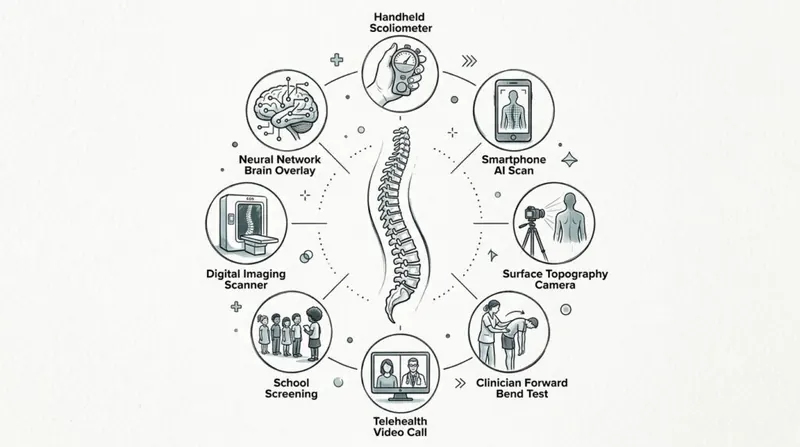
For a Thoracic Curve (Upper Back): The classic way to check is with the Adam's Forward Bend Test. As you bend forward, look for a "rib hump," or one side of your upper back that looks more prominent. That raised area is your convex side. The flatter, opposite side is your concave side.
For a Lumbar Curve (Lower Back): Take a look at your waistline. You might notice one side seems to have a deeper crease or looks more "cinched-in"; that's typically your concave side. The fuller, less-defined side is your convex side.
If you have a primary thoracic curve, you might also notice one shoulder sits higher than the other; it's often the one on the convex side. With a lumbar curve, one hip can appear higher. Knowing your specific pattern is the key to unlocking an exercise program that truly works for you, not against you.
While the exercises below are specific and asymmetrical, always remember they build upon a stable core. This simple chart helps you remember where to start with those foundational movements.
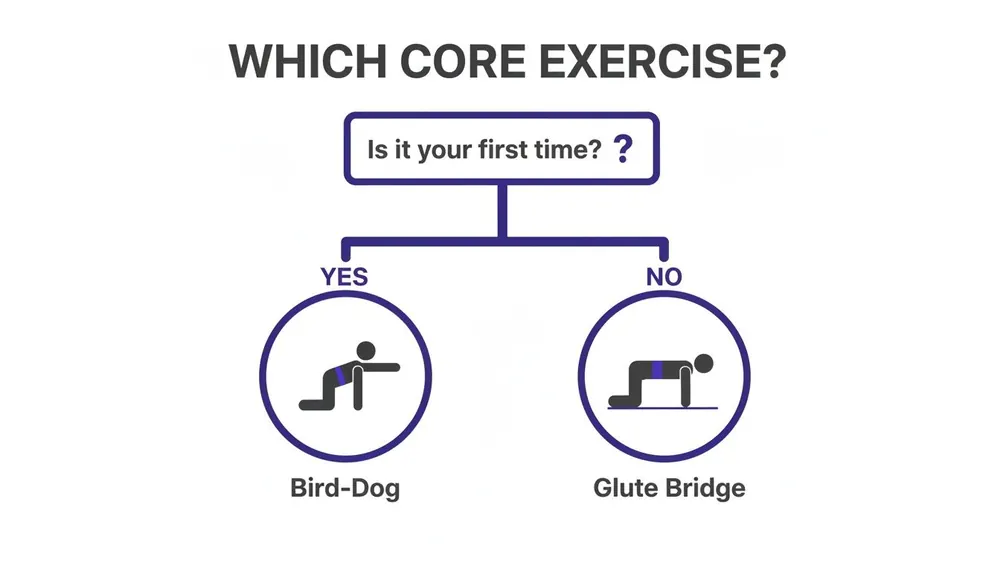
This just illustrates how even your basic warm-ups can be selected based on your experience level, ensuring you master stability before moving on to more complex, targeted work.
Targeted Asymmetrical Exercises in Action
Let's walk through how this works with a very common pattern: a right thoracic scoliosis. This means the curve in the upper back pushes out to the right (the convex side) and is hollow on the left (the concave side).
1. Strengthening the Convex Side: Side Plank on Convex Elbow
The Side Plank is already a fantastic core exercise, but we can supercharge it for scoliosis. For someone with a right thoracic curve, you’ll perform the plank resting on your right elbow.
Why it works: This position makes the weak, overstretched muscles on the right (convex) side of your trunk work overtime to lift your body and stop it from sagging. It's a direct line to activating the exact muscles we need to get stronger.
Get set up: Lie on your right side, making sure your elbow is directly underneath your shoulder. If you're new to this, start with your knees bent. For a greater challenge, keep your legs straight.
The movement: Press through your forearm and lift your hips off the floor, creating one long, straight line from your head to your feet (or knees). The most important cue here is to actively "lift" your right ribs up toward the ceiling, fighting gravity's pull.
The goal: Hold for 15-30 seconds with perfect form. You’ll do 2-3 sets on this convex side only.
2. Waking Up the Concave Side: Single-Arm Row
Now we shift focus. We need to wake up the muscles deep inside that concave hollow. For our right thoracic curve example, that means we're working the left side.
Why it works: A Single-Arm Row is perfect for getting the rhomboids and mid-trapezius muscles on the concave (left) side to fire up. These muscles have often "gone quiet" and need to be re-engaged to help pull the spine and shoulder blade back toward a more centred position.
Get set up: You can stand in a split stance or kneel on a bench with one knee, holding a light dumbbell or resistance band in your left hand.
The movement: Keep your back flat and brace your core. Now, pull the weight up toward your chest, focusing intently on squeezing your left shoulder blade back and down. A tip I give clients: imagine you're starting the pull from your back, not just yanking the weight with your arm.
The goal: Perform 10-12 controlled reps for 2-3 sets, again, only on this concave side.
3. Stretching the Concave Side: Side-Lying Stretch
Finally, we need to create some space and length in those tight, compressed muscles on the concave side.
Why it works: This stretch helps to de-rotate and open up the collapsed ribcage on the concave (left) side. It lengthens the tight lat and oblique muscles and, just as importantly, encourages you to breathe into that compressed area.
Get set up: Lie on your right (convex) side. You can place a small pillow or a rolled-up towel under your right ribs to deepen the stretch a bit.
The movement: Reach your left arm up and over your head, feeling a long, gentle stretch all the way down the left side of your body. Take slow, deep breaths. With every exhale, imagine your left ribs expanding and opening up like an accordion.
The goal: Hold this gentle stretch for 30-60 seconds, really focusing on your breath. Repeat 2-3 times.
Using Technology for Smarter Scoliosis Management
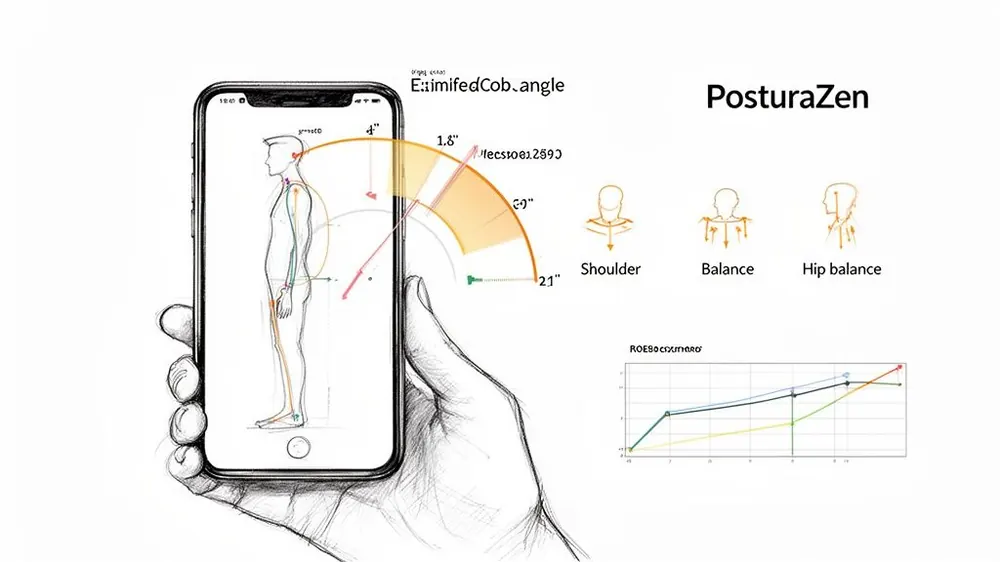
While the right back exercises for scoliosis are the cornerstone of conservative care, one of the biggest frustrations has always been tracking progress. For years, the only way to get a clear picture was with periodic X-rays, which meant infrequent updates and unavoidable radiation exposure.
Thankfully, we're now in an era where accessible technology is closing that gap. Think about getting a clear, data-driven look at your posture without leaving your house. Platforms like PosturaZen turn your smartphone into a surprisingly powerful tool for monitoring your spine, connecting what you do at home every day with the guidance you get in the clinic.
Radiation-Free Progress Tracking
The real game-changer here is the ability to see how your body is changing without radiation. By using your phone’s camera and smart analysis, these tools can give you solid estimates of key postural metrics that you used to only see on an X-ray.
You can now keep an eye on things like:
Estimated Cobb Angle: Get an approximation of your curve’s severity. This isn't for diagnosis, but for tracking trends over time. Is it stable? Improving?
Shoulder and Hip Balance: See tangible proof of how your exercises are helping to level out your shoulders and pelvis.
Postural Sway and Alignment: Get a better sense of your body's position in space and pinpoint asymmetries that need more focus.
Being able to check in on your posture regularly provides a huge motivational boost. When you see a small but measurable improvement in your shoulder height on a progress chart, it proves your hard work is paying off. That makes sticking with your program so much easier.
By turning a subjective feeling like "I think I'm standing straighter" into objective data, you gain a whole new level of control over your care. It shifts scoliosis management from a passive, reactive task to a proactive, informed process.
The Feedback Loop: A User’s Journey
So, what does this look like in practice? It creates a really effective feedback loop between you, your exercises, and your clinician.
It all starts with a baseline scan. You simply use your smartphone to capture your posture from a few angles. The app analyses the images and generates a detailed report, showing your estimated Cobb angle, shoulder tilt, and other key metrics. This gives you and your therapist a clear, objective starting point.
Next, you dive into your personalised exercise plan, but you're not on your own. The AI Workout Companion acts like a virtual coach. It uses your phone's camera to give you real-time verbal cues on your form, making sure every repetition is done correctly and safely.
For example, if you're doing a side plank and your hips start to sag, the AI might chime in with, "Lift your hips higher." This instant feedback is crucial for ensuring your scoliosis exercises are actually therapeutic and not reinforcing bad habits.
Bridging Clinic-to-Home Care
After a few weeks of consistent work, you do a follow-up scan. The app compares this new data to your baseline, showing your progress in easy-to-read charts. You can then share this information directly with your physiotherapist.
This remote connection is incredibly valuable. It allows your therapist to see exactly how your body is responding to the program and make quick, informed adjustments without you needing to come in for every little tweak. You can learn more about the tech behind this in our article on AI-powered scoliosis detection with a smartphone.
This data-driven approach is especially important when you consider the realities of surgical care. For instance, a California-based study of over 3,600 scoliosis surgeries found that outcomes were closely tied to the hospital's experience level. For a population where adolescent scoliosis incidence is 393 per 100,000, tools that enable precise, monitored exercise programs are vital for managing curves and potentially delaying or even avoiding surgery. You can read the full research on surgical outcomes here to learn more.
Here’s the rewritten section, crafted to sound like it was written by an experienced human expert.
Crafting a Weekly Exercise Plan That Actually Works
So, you have your list of scoliosis-specific exercises. That’s a fantastic first step. But the real game-changer, the thing that will truly move the needle on your progress, is weaving those exercises into a consistent weekly routine. We’re aiming to build a sustainable habit, not just a list of good intentions.
One of the biggest hurdles I see people face is trying to do too much, too soon, which almost always leads to burnout. A smarter approach is to give each workout a specific theme. This keeps things fresh and ensures you're hitting all the critical components for managing scoliosis: stability, targeted strength, and much-needed mobility.
How to Structure Your Week for Real Results
Instead of grinding through the same full routine every day, try dedicating certain days to different goals. This gives your muscles time to recover properly and helps you mentally dial in on what you’re trying to achieve in each session. Think of it as building a balanced diet for your back.
For example, you could start the week by reinforcing your core foundation, hit the more challenging corrective work mid-week, and wrap up with a session focused purely on mobility and release.
Here’s what that could look like:
Core Stability Day: This is all about going back to basics. Think perfect-form Bird-Dogs and Glute Bridges. The goal isn't to break a sweat; it’s about deep, precise muscle activation.
Asymmetrical Strength Day: This is your most focused, high-impact session. It’s where you’ll put your energy into the specific corrective exercises for your curve, like the side planks and single-arm rows we’ve already discussed.
Mobility and Recovery Day: Time to breathe and release. Focus on gently stretching the tight, concave side of your curve and practising your corrective breathing techniques. This is also a perfect day for some light, low-impact activity like a walk or a swim.
And please, don't forget to rest. Building at least one or two full rest days into your week isn't lazy; it’s essential for muscle repair and sidestepping those frustrating overuse injuries.
A Pro Tip From Experience: Don't get married to a rigid Monday-Wednesday-Friday schedule. The key is to listen to your body. If you're feeling unusually sore or just plain tired, swapping a strength day for a mobility session or taking an extra day off is the smart move. Long-term consistency will always trump a single "perfect" week.
Turning Your Plan Into a Lasting Habit
A plan on paper is one thing, but making it happen consistently is the real challenge. This is where a bit of modern technology can be a huge ally. Using an app like PosturaZen can help transform your exercise list into a structured, motivating program that feels less like a chore.
Imagine you've scheduled your "Asymmetrical Strength" session for Wednesday. You get a reminder, and when it’s time to start, you can fire up the AI Workout Companion. It acts like a virtual coach, guiding your movements to make sure your form is spot-on for every single repetition. That's how you make every workout count.
After you’re done, you can log the session. The app’s progress charts give you a powerful visual of your own consistency. Honestly, seeing a calendar fill up with completed workouts is one of the best motivators there is. This kind of support bridges the gap between knowing what you should do and actually doing it, creating a framework that makes your exercises a non-negotiable part of your week.
To give you a clearer picture, here is a sample schedule you can adapt to fit your own life and curve pattern.
Sample Weekly Scoliosis Exercise Schedule
This table provides a simple template for how you might organise your week. Feel free to adjust the days to suit your energy levels and personal schedule.
| Day of the Week | Focus Area | Example Exercises | Tech Integration (PosturaZen) |
|---|---|---|---|
| Monday | Core Stability & Foundations | Glute Bridges, Pelvic Tilts, Dead Bugs | Use the AI Companion for form feedback on foundational moves. |
| Wednesday | Asymmetrical Strengthening | Side Plank on convex side, Single-Arm Row on concave side | Set a recurring reminder and track the session in your activity log. |
| Friday | Mobility & Corrective Breathing | Side-Lying Stretch for concave side, Cat-Cow | Use the app to schedule a shorter, recovery-focused session. |
| Tue/Thu/Sat/Sun | Active Recovery & Rest | Light walking, swimming, or complete rest | Log any active recovery to see a full picture of your weekly activity. |
Ultimately, the best plan is the one you can stick to. Use this as a starting point, listen to your body and your physiotherapist, and build a routine that truly supports your journey to a stronger, more balanced back.
Common Questions About Exercising with Scoliosis
When you're starting a new exercise plan for scoliosis, it's natural to have a lot of questions. In fact, it's a good thing; it means you're invested in doing this right. Let's walk through some of the most common concerns we hear from people, so you can move forward with clarity and confidence.
Can Exercise Actually Fix My Scoliosis?
This is usually the first question on everyone's mind, and it deserves an honest answer. The short answer is no; exercises can't completely straighten a structural curve that has already formed. We're talking about a fixed change in the shape of the vertebrae themselves.
But that's far from the whole story. The power of scoliosis-specific exercise is immense. It is your single best tool for managing the condition – slowing or even stopping a curve from getting worse, especially for adolescents. More than that, these movements are proven to reduce pain, dramatically improve your posture, and build the specific muscular support your spine needs for a much better quality of life.
What Exercises Are Dangerous for Scoliosis?
While staying active is key, it's true that not all movements are helpful for a scoliotic spine. Some exercises can create uneven stress on your vertebrae, which might make your pain or asymmetry worse over time.
It’s generally a good idea to be mindful of:
Unsupported Spinal Twists: Think of deep, forceful twisting stretches, sometimes found in yoga or general fitness classes, where your core isn't braced. These can put too much strain on the peak of your curve.
High-Impact Activities: The repetitive jolting from activities like long-distance running or some high-impact aerobics can compress the spine unevenly.
Loaded Spinal Flexion: Movements that involve rounding your lower back under load, like traditional sit-ups or crunches, can place a lot of pressure on your spinal discs and reinforce the very postural habits we're trying to correct.
The goal isn't to wrap yourself in cotton wool. It's about choosing movements that build balanced strength instead of ones that feed into existing imbalances.
How Long Until I Notice a Difference?
Patience and realistic expectations are your best friends here. You’ll probably start to feel a difference fairly quickly, often within a few weeks. This usually shows up as less day-to-day pain, reduced muscle tension, and just a better overall awareness of how you hold yourself.
True, measurable changes in your posture, strength, and stability take more time and consistency. You should be thinking in terms of months, not weeks. Your body is essentially unlearning old habits and building new muscle memory, and that's a gradual process.
Can I Do This All on My Own?
While we admire the initiative, we strongly recommend starting this journey with a professional. Seeing a physiotherapist who specialises in scoliosis for an initial evaluation is one of the best investments you can make.
That first consultation is incredibly valuable. It gives you a personalised roadmap, ensuring the back exercises you do for your scoliosis are exactly what your specific curve needs. Armed with that expert guidance, you can then manage your program confidently at home, using the right tools to stay on track and make sure all your hard work pays off.
Ready to put this knowledge into practice? PosturaZen gives you the tools to effectively manage your exercise program. Our AI Workout Companion provides real-time feedback on your form, and our progress tracking helps you see your improvements, bridging the gap between clinical advice and your daily routine. Take the next step in managing your scoliosis by learning more at PosturaZen.com.