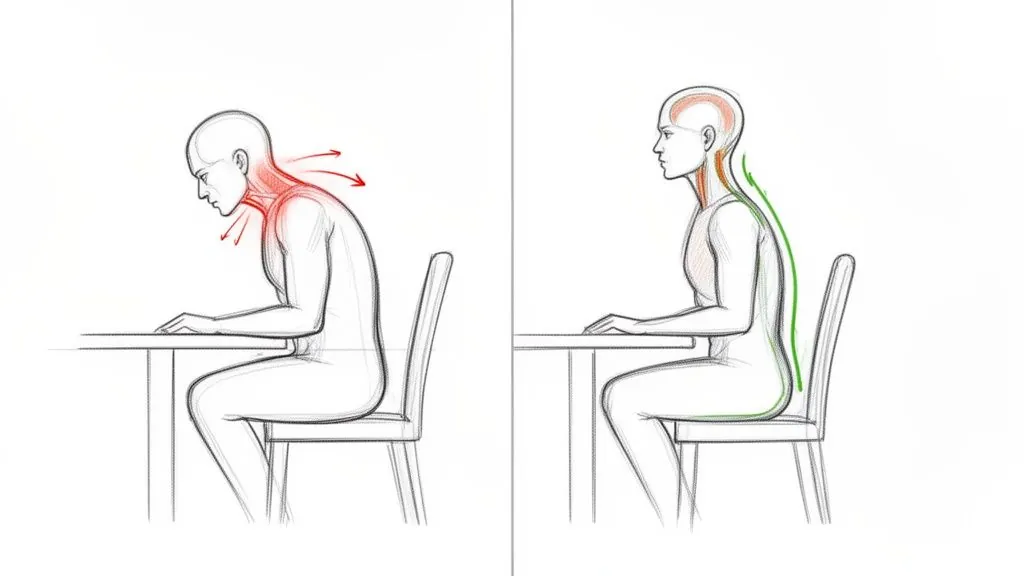
If you want to fix forward head posture, you can't just focus on one thing. The real solution involves a two-pronged attack: you need to stretch the tight, shortened muscles at the front of your chest and neck while also strengthening the weak, overstretched muscles in your upper back and the deep part of your neck.
When you pair these exercises with some smart changes to your daily habits and workspace, you start to naturally guide your head back over your shoulders, taking a massive amount of strain off your body.
Why Is Everyone Talking About Tech Neck?
That nagging ache at the base of your skull or the constant tension across your shoulders isn't just you being tired. More often than not, it's a classic sign of "tech neck," which is really just the modern-day term for forward head posture. And trust me, it's more than just a cosmetic issue; it's a serious biomechanical problem.
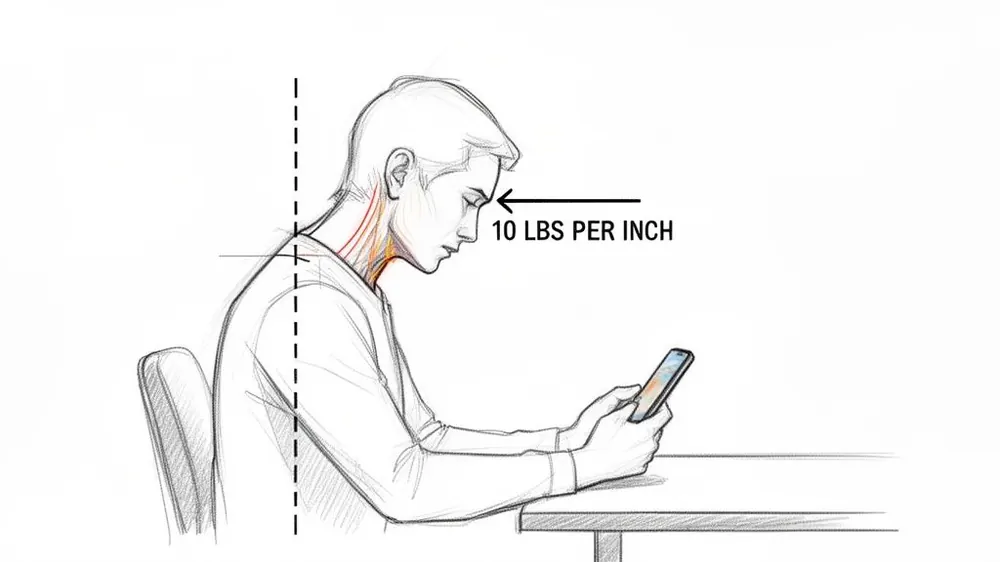
Your head is heavy, but your spine is brilliantly designed to carry it without any effort when everything is stacked correctly. The problem starts the moment your head drifts forward from that neutral alignment, which happens every time you look down at a phone, hunch over a laptop, or even read a book. The physics of it are brutal.
Think of it this way: for every inch your head juts forward, it adds an extra 10 pounds (4.5 kg) of force for your neck and upper back to deal with. It’s like strapping a bowling ball to your forehead and asking your muscles to hold it there all day.
This constant overload doesn't just create local pain. It forces the rest of your body into a state of compensation, triggering a cascade of other problems as different muscles try to pick up the slack.
The Widespread Impact of Poor Posture
Forward head posture has exploded into a major health issue for our screen-focused generation, and the statistics are pretty eye-opening. It's now one of the most common postural imbalances I see, especially in younger people. One study found that 28.38% of teenage girls already show signs of it. By the time they get to university, that number can climb as high as 73%, according to some reports. It’s a problem that tends to get worse over time, often peaking between ages 31 and 35. This detailed research summary on young adults paints a clear picture of just how prevalent this has become.
What’s concerning is how many people suffer from related symptoms without ever realising their posture is the culprit. Understanding the full picture is key, which is why we put together a guide on the surprising side effects of bad posture.
More Than Just a Pain in the Neck
While neck pain is the most obvious complaint, the ripple effect from a forward head position can show up in ways you'd never expect. This misalignment can be the hidden source of a whole host of issues, including:
Chronic Tension Headaches: That constant pull on the small muscles at the base of your skull is a primary trigger for those dull, persistent headaches that won't go away.
Shoulder and Upper Back Pain: Your upper back muscles, like the trapezius and rhomboids, get stretched thin and weak, leading to that familiar burning or aching feeling between your shoulder blades.
Reduced Lung Capacity: Slouching forward literally compresses your chest and rib cage. This restricts your diaphragm and makes it physically harder to take a deep breath, which can cut your oxygen intake and leave you feeling fatigued.
Jaw Pain (TMJ): Shifting your head's centre of gravity throws off the mechanics of your jaw. Over time, this can lead to clicking, popping, and pain in the temporomandibular joint.
Making this connection is the first real step toward feeling better. Straightening up your posture isn't just about looking taller or more confident; it's about reversing the silent damage our modern lifestyle is doing to our bodies and reclaiming your long-term health.
Of course. Here is the rewritten section with a more natural, human-written tone.
How to Assess Your Head Posture in Under Five Minutes
Before you can start correcting your posture, you need to know exactly where you’re starting from. Guesswork won't get you very far here. The great thing is, you don’t need a special appointment to get an objective look at your alignment – you can do it right now with a wall and your smartphone.
Think of this as your "before" picture. Establishing this clear baseline is what makes your progress down the road feel so tangible and rewarding. Let’s start with the quickest method.
The Quick Wall Test
The wall test is a classic for a reason. It’s fast, simple, and gives you instant physical feedback on how your body is positioned in space. It's a fantastic way to build awareness of your natural resting posture without overthinking it.
Find a flat wall and stand with your back against it, placing your feet about six inches out. From there, try to get four key points of your body to touch the wall at the same time:
The back of your head
Your shoulder blades
Your buttocks
Your heels
If you can rest all four points against the wall comfortably, without straining or feeling awkward, your alignment is probably in pretty good shape.
However, if your shoulders and glutes are touching but your head is floating an inch or more away from the wall, that’s a tell-tale sign of forward head posture. The key is not to force it. The whole point is to see where your head rests naturally.
That gap you feel between the wall and the back of your head? That's a physical representation of how far forward your head has drifted from its ideal spot over your shoulders. This simple test makes an invisible problem feel very real.
The More Precise Photo Analysis
While the wall test provides excellent physical feedback, a photo gives you visual data you can actually measure and track over time. For this, your smartphone is the perfect tool.
Have a friend snap a photo of you from the side, or just set your phone on a timer. The most important part is to stand in your normal, completely relaxed posture. Don't try to "fix" it for the camera – we want to see the real you. Make sure the picture captures your full head, neck, and shoulders.
Once you’ve got the shot, take a close look at one key alignment marker: the position of your ear relative to your shoulder. Imagine a perfectly vertical line dropping down from the opening of your ear. In ideal alignment, that line should pass right through the centre of your shoulder (specifically, the acromion, which is that bony point at the very top).
If your ear is clearly in front of that shoulder line, you now have visual proof of forward head posture. The bigger the distance, the more pronounced the issue.
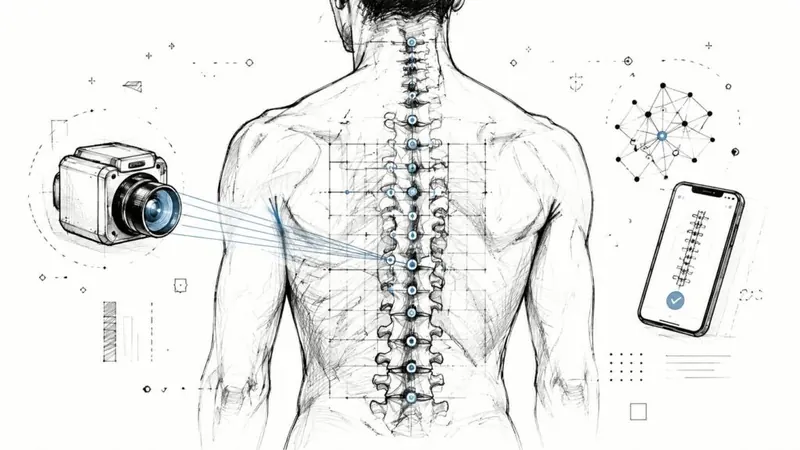
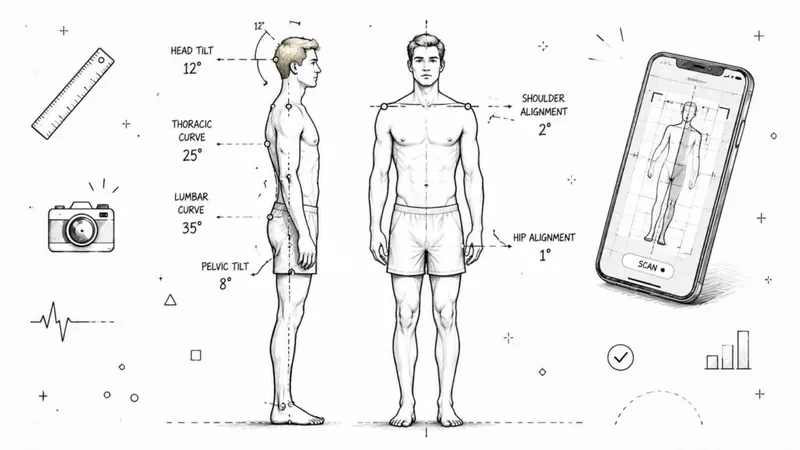
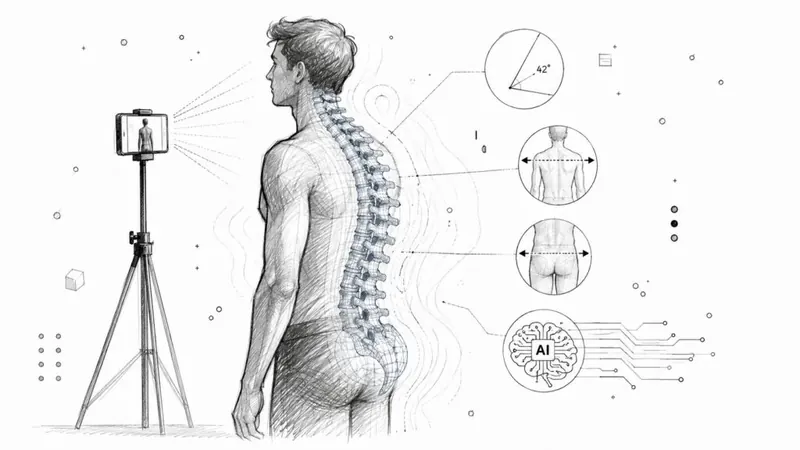
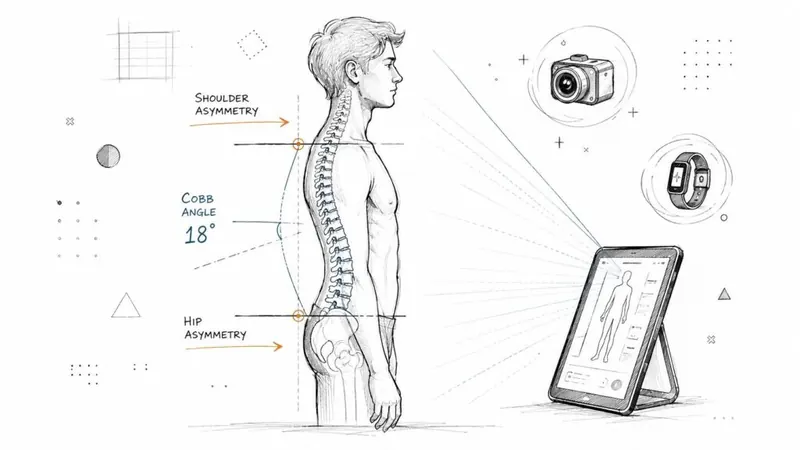
This is the kind of visual data that apps like PosturaZen are built to analyse with incredible precision. By uploading your photo, the platform can calculate your specific craniovertebral angle (CVA). A smaller CVA points to a more significant forward head position, giving you a concrete number to focus on improving.
To help you put all this together, here’s a quick checklist to guide your self-assessment.
Forward Head Posture Self-Assessment Checklist
Use this checklist to perform a quick self-assessment and interpret the results of your wall test and photo analysis.
| Assessment Method | What to Look For (Good Posture) | Signs of Forward Head Posture |
|---|---|---|
| The Wall Test | The back of your head, shoulder blades, buttocks, and heels all comfortably touch the wall. | A noticeable gap between the back of your head and the wall when your shoulders and buttocks are touching. |
| The Photo Analysis | An imaginary vertical line from your ear canal passes through the centre of your shoulder. | Your ear is positioned clearly in front of the vertical line of your shoulder. |
| Subjective Feeling | You feel tall and light; your neck feels relaxed when sitting or standing. | Chronic neck tension, upper back aches, or a feeling of heaviness in your head and neck. |
Using these simple tests gives you a solid, objective starting point. Now you know what you're working with, and you'll be able to clearly see the improvements as you begin the corrective exercises.
Alright, you've assessed your posture. Now for the most important part: the actual work. Getting your head back where it belongs isn't about doing a bunch of random stretches. It requires a smart, two-pronged attack.
First, we need to lengthen the tight, overactive muscles on the front of your body that are pulling you into a slump. Then, we'll wake up and strengthen the sleepy, underused muscles in your upper back and deep neck that are supposed to be holding you upright. This one-two punch is what creates real, lasting change by essentially reteaching your body what its natural, healthy posture should feel like.
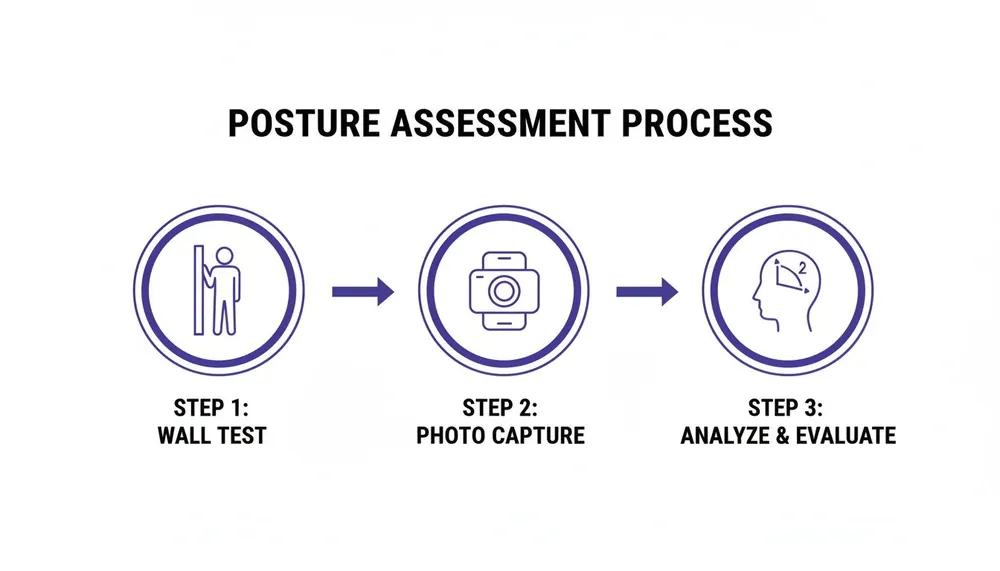
This is a quick look at the simple assessment process we've already covered: the wall test, snapping a quick photo, and analysing your alignment. It gives you a clear starting point so you can actually see your progress as you work through the exercises below.
Stretching the Tight Front-Line Muscles
All those years of your head creeping forward have left the muscles in your chest (your pecs) and the front of your neck incredibly tight. They're basically stuck in a shortened state, constantly yanking your head and shoulders forward. Our first mission is to convince them to let go.
The Doorway Pectoral Stretch is perfect for this. Find an open doorway and place your forearms on the frame. Your elbows should be bent at a 90-degree angle and just a bit below shoulder height. Now, take a small step forward with one foot until you feel a good, solid stretch across your chest.
Breathe into it and hold for 30 to 45 seconds. You’re looking for a lengthening sensation, not pain. Do this 2-3 times. You can play with the height of your arms on the frame to hit different parts of your chest muscles.
A key tip here: brace your core and try not to arch your lower back. The stretch should be all in your chest and the front of your shoulders. Let your body weight create the stretch instead of forcing it.
Strengthening the Weak Back-Line Muscles
Stretching opens things up, but strength is what will keep you there. The muscles in your upper back, especially the rhomboids and mid-traps, are what pull your shoulder blades back and down, building a strong foundation for your neck and head.
A fundamental move for this is the Scapular Retraction, or what I just call a shoulder blade squeeze. You can do this anywhere, sitting or standing. Start by sitting or standing tall with your arms relaxed by your sides.
Without letting your shoulders creep up to your ears, gently draw your shoulder blades together like you're trying to pinch a pencil between them. Feel that squeeze, hold it for 5-10 seconds, and then slowly release. Aim for 2 sets of 10-12 repetitions. Focus on the quality of the squeeze; it's not about how hard you can pull.
Activating the Deep Neck Flexors
Now for the MVP in this whole process: the deep neck flexors. These tiny muscles sit right at the front of your spine in your neck, and their main job is to hold your head directly over your shoulders. For anyone with "tech neck," these muscles have usually gone on a long vacation.
The absolute best exercise to wake them up is the Chin Tuck. Lie on your back, knees bent, with your head flat on the floor (no pillow). Think about making your neck long, as if a string is gently pulling the back of your head away from your shoulders.
From that position, give a tiny little nod, tucking your chin down towards your throat. It's a subtle movement. You should feel a gentle tension deep in the front of your neck. Hold for 5 seconds, then relax. Try to complete 2 sets of 10 repetitions. Whatever you do, don't lift your head off the floor or jam your chin down hard.
Putting It All Together
Once you're comfortable with each exercise on its own, you can start combining them. For instance, try doing a chin tuck while you're also doing a gentle shoulder blade squeeze. This is powerful because it starts to train your muscles to work together as a team, just like they need to throughout your day.
Remember, consistency beats intensity every time. Doing these exercises for just 5-10 minutes every single day will give you far better results than one long, painful session a week. You're building new habits in your nervous system, and that requires frequent practice. As you get stronger, you can hold the positions longer or even add a light resistance band to your shoulder blade squeezes.
Building a Posture-Friendly Workspace and Life
The exercises we've covered are crucial, but they can't do all the heavy lifting on their own. You can perform chin tucks perfectly all day, but if you immediately spend hours hunched over a laptop, you're essentially taking one step forward and two steps back. To truly fix forward head posture for good, you need to look at your environment and daily habits.
This is where we build posture mindfulness – simply becoming more aware of how you hold your body throughout the day. Your workspace is the first, and often most important, place to start. It's where so many of these bad habits are formed and reinforced day after day.
Optimising Your Workstation Ergonomics
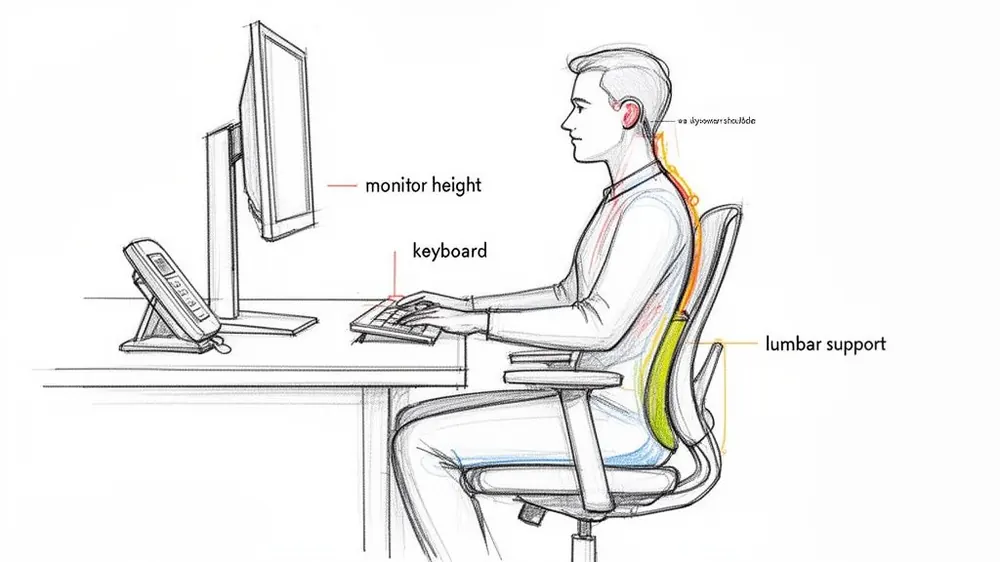
Getting your desk setup right isn't about buying the most expensive ergonomic chair. It’s about arranging what you already have to fit your body, creating a space where a neutral, relaxed posture feels like the most natural way to sit.
Here’s a quick audit you can do on your main workspace right now:
Monitor at Eye Level: This is the biggest one for tech neck. The top of your screen should be right at, or just a touch below, your eye level. This single change prevents your head from creeping forward and down. Don't have a fancy monitor arm? No problem. A stack of books or a sturdy box works just fine.
Keyboard and Mouse Placement: Bring your keyboard and mouse close enough so your elbows can rest near your sides, bent at a comfortable 90-degree angle. If you're constantly reaching for your mouse, you're encouraging your shoulders to round forward.
Support Your Lower Back: A slouched lower back is the foundation for a slouched upper body. Your head will always follow. Your chair should have decent lumbar support, but if it doesn't, just roll up a small towel or grab a cushion and place it in the curve of your low back. This simple trick helps maintain your spine's natural curve.
The secret to great ergonomics is making good posture the path of least resistance. When your monitor is at the right height, and your back has support, sitting tall feels easy and natural, not like a chore.
There's plenty of science to back this up. Research clearly shows that poor workplace ergonomics are linked to higher neck disability scores. On the flip side, making the right adjustments leads to measurable improvements. You can dig into the research linking ergonomics and posture correction for yourself. This is exactly why a complete approach, like the one we use at PosturaZen, is so effective; it combines targeted exercises with these crucial environmental tweaks for results that actually stick.
Extending Posture Awareness Beyond the Desk
Forward head posture isn't just a 9-to-5 problem; it follows you home, into your car, and onto your couch. To create lasting change, you have to stay mindful during all those other hours of the day.
Think about the common culprits and how you can flip the script:
Texting and Scrolling: We all do it. But instead of dropping your head to look at your phone, try lifting your phone to your eye level. It feels a little weird at first, I get it, but it makes a massive difference in the strain on your neck.
Driving Your Car: That headrest isn't just for a crash. Adjust it so it’s close enough to gently graze the back of your head when you're sitting up straight. It acts as a physical cue, reminding you to keep your head back over your shoulders and avoid that classic "driving slump."
Reading a Book or Tablet: Just like with your phone, don't crane your neck down. Prop your book or tablet up on a pillow in your lap, or use a simple stand on a table.
Every one of these moments is a chance to reinforce good posture. By making these small, conscious shifts throughout your day, you start to rewire your brain's default settings. Over time, good posture becomes your new normal – something you don't even have to think about anymore. That's how you make this a permanent change.
How to Track Your Progress and Stay Motivated
Let's be realistic: it took years for your posture to get to this point, and it won't fix itself overnight. Think of this as a long-term project. The key to sticking with it is seeing concrete proof that your hard work is actually paying off. This isn't just about accountability; it’s about giving yourself tangible wins that build momentum for the long haul.
So, what can you really expect? Most people start to feel a difference within just a few weeks of being consistent. You might notice your neck feels less tight after a long day, or those tension headaches start to fade. That’s the first sign you're on the right track. The visible, structural change, the kind you can clearly see in a picture, takes longer, often several months.
Going Back to Your Starting Point
The most powerful way to see how far you’ve come is to revisit those simple checks we did at the very beginning. This creates a compelling ‘before and after’ story that’s all yours.
Remember that side-profile photo you snapped? Plan to retake it every four to six weeks. Don't be tempted to check more often; progress is slow and steady, and looking for daily changes will only leave you feeling discouraged. When you put those photos side-by-side after a few months, you’ll likely be shocked to see your ear slowly migrating back into alignment over your shoulder.
The wall test is another fantastic check-in you can do weekly. Stand with your back against the wall as you did initially. Is the space between the wall and your head getting smaller? Does it feel less like a strain to get there? This physical feedback is incredibly rewarding.
Remember, progress isn’t just what you see in a photo. It’s also about how you feel in your body day-to-day. Are you suddenly noticing your head rests comfortably on the car's headrest without you forcing it back? Are you catching yourself and sitting up straight at your desk before the slump even starts? Those are huge wins.
Using Tech for Unbiased Feedback
While photos and physical tests are great, modern tools can give you the kind of objective feedback that keeps you going when motivation starts to dip. This is where you can get really precise.
Apps like PosturaZen’s AI posture analysis turn your phone into a surprisingly powerful assessment tool. It analyses your photo and gives you hard numbers, like your exact craniovertebral angle (CVA). Instead of just guessing if your posture looks better, you can see that angle improving over time on a clear chart.
Seeing that number change removes all the guesswork. It’s tangible proof that your chin tucks and desk adjustments are creating real, biomechanical change in your body.
Seeing the Bigger Picture of Your Health
Tracking these changes matters because forward head posture isn't just an aesthetic issue; its effects can ripple through your entire body. Research has clearly shown how it can limit neck mobility and has even linked it to changes in breathing and heart function. For instance, studies confirm a strong connection between forward head posture and reduced cervical flexion: a fancy way of saying a stiffer, less mobile neck. You can read more about the far-reaching health impacts of posture in this PLOS ONE study.
This is why keeping track is so crucial. As your posture improves, you aren't just getting rid of a sore neck; you're actively supporting your body's overall health.
Try keeping a simple journal to jot down a few notes each week. It doesn't have to be complicated:
Pain Levels: On a scale of 1-10, how's your neck or shoulder pain this week?
Energy & Focus: Do you feel less drained by the end of the workday?
Mobility: Is it easier to turn your head to check your blind spot in the car?
When you combine the visual proof from photos, the hard data from an app, and your own notes on how you feel, you get a complete picture of your progress. This approach gives you all the encouragement you need to turn these exercises and habits into a permanent part of your life.
Common Questions About Fixing Forward Head Posture
As you begin working on your posture, some questions are bound to come up. It's completely normal. Getting clear on the details can be the difference between sticking with it and giving up. Let's tackle some of the most common uncertainties I hear from people.
How Long Does It Actually Take to See a Difference?
This is always the first question, and the honest answer is: it depends, but you can think about it in two stages.
You'll likely start to feel better surprisingly quickly, often within 2 to 4 weeks. This is when you'll notice the initial benefits of consistent exercises and better habits. Think less neck strain after work, fewer tension headaches, and a general feeling of looseness in your upper back. Your muscles are waking up and adapting.
Actually seeing a structural change in the mirror or in a photo is the long game. Lasting, visible correction can take anywhere from 3 to 6 months or more. Remember that forward head posture probably took years to develop; it takes time and dedication to retrain your body.
Don't get discouraged if you don't see a dramatic difference in photos after a month. Focus on how much better you feel; that’s the real sign you're on the right track.
Does My Pillow and Sleep Position Really Matter?
Yes, it matters a great deal. You spend about a third of your life in bed, and if your neck is in a bad position all night, you're actively working against all the progress you make during the day.
The whole point of a good pillow is to keep your neck in a neutral position. It should just fill the gap between your head and the mattress, maintaining a straight line through your spine.
A pillow that’s too high forces your head forward into that classic "tech neck" position for eight hours straight. One that's too flat lets your head drop back, straining the muscles and joints.
Here’s a practical look at how your sleeping style affects your neck and what kind of pillow can help.
Sleep Positions and Pillow Types for Neck Health
The table below breaks down the best and worst positions for your neck and the ideal pillow to support a healthy alignment.
| Sleeping Position | Impact on Neck Alignment | Recommended Pillow Type |
|---|---|---|
| Back Sleeping | Best. This position allows your head, neck, and spine to rest in a neutral, natural alignment. | A thinner, contoured pillow. You want something that supports the natural curve of your neck without propping your head up too high. |
| Side Sleeping | Good. You can easily maintain a neutral spine, but only with the right pillow height. | A firmer, thicker pillow. It needs to be substantial enough to fill the entire space between your ear and the outside of your shoulder to keep your head level. |
| Stomach Sleeping | Worst. This forces your head to be twisted sharply to one side for hours, which puts a huge amount of stress on your cervical spine. | If you absolutely can't break the habit, use a very thin pillow or no pillow at all. This minimises the unhealthy angle of your neck. |
Dialing in your sleeping setup is one of the most powerful changes you can make, as it helps your body heal and adapt around the clock. For a deeper dive, check out our other articles on general posture improvement.
When Is It Time to See a Professional?
While this program can create incredible change, it's also important to know when to call in an expert. Self-correction has its limits, and a professional can offer a more targeted approach.
You should seriously consider booking an appointment with a physiotherapist, chiropractor, or your doctor if you run into any of these red flags:
Pain That Won't Quit: The soreness and stiffness aren't getting better after a few weeks of consistent effort, or it's actually getting worse.
Numbness or Tingling: You're feeling pins-and-needles, weakness, or strange sensations radiating down your arms or into your hands. This can signal nerve compression.
Severe Headaches or Dizziness: If headaches are becoming debilitating or you're experiencing dizziness, it's crucial to get a professional evaluation.
You've Hit a Plateau: You’ve been diligent for a couple of months but feel completely stuck, with no noticeable improvement in how you feel or look.
A professional can give you a precise diagnosis, use manual therapy to release stubborn tissues that exercises alone can't fix, and create a plan that’s 100% customised to your body.
With PosturaZen, you can take the guesswork out of correcting your posture. Our AI-powered platform provides clinical-grade analysis of your alignment and guides you through corrective exercises with real-time feedback, helping you build a stronger, healthier posture right from home. Track your progress, stay motivated, and see the results of your hard work. Learn more about how PosturaZen can transform your posture journey.